
Fire Protection in Modern Industrial Facilities
What should developers, tenants and brokers be considering before a warehouse is selected or designed?
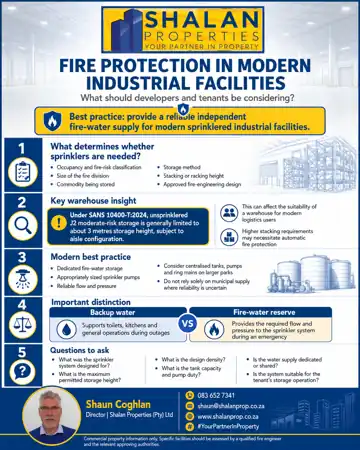
Fire protection is becoming an increasingly important part of the design, operational suitability and commercial viability of modern industrial and logistics facilities.
For occupiers, developers and brokers, the question is not simply whether a warehouse has sprinklers. The more useful question is whether the complete fire-protection system has been designed for the building's occupancy, the commodity being stored, the storage configuration and the intended stacking height.
What determines whether sprinklers are needed?
- occupancy and fire-risk classification;
- size and configuration of the fire division;
- commodity being stored;
- storage method, including block stacking, pallets or racking;
- stacking or racking height; and
- the approved fire-engineering design and applicable standards.
Storage height can change the answer
SANS 10400-T:2024 is particularly relevant to unsprinklered storage occupancies. Its deemed-to-satisfy provisions set maximum design stacking heights where there is no fixed automatic fire-extinguishing installation. For J2 Moderate Risk Storage, the maximum design stacking height is 3 metres, subject to the applicable aisle configuration and the other provisions of the standard.
That distinction matters commercially. A logistics occupier intending to stack to 6 metres, 8 metres or higher may find that an otherwise attractive warehouse is not suitable without an appropriately designed automatic fire-protection solution.
Sprinklers are only part of the equation
A sprinkler installation is only as effective as the system behind it. The fire-protection design needs to consider design density, required flow, pressure, fire-water storage, pump duty, commodity, storage configuration and maximum permitted storage height.
Where municipal supply reliability or pressure is uncertain, a dedicated and appropriately engineered fire-water supply can materially improve resilience. Larger industrial parks may also use centralised tanks, pumps and ring-main infrastructure, subject to the approved fire-engineering design.
Backup water is not necessarily fire water
A normal backup-water tank intended to keep toilets, kitchens and operational processes functioning during a municipal outage is not automatically equivalent to a dedicated fire-water reserve. A fire-water system must be designed to provide the flow and pressure required by the approved sprinkler or suppression system.
“Fully sprinklered” does not tell the whole story
When assessing an industrial property, developers, tenants and brokers should look beyond the headline description and establish what the system was actually designed to protect.
- What occupancy and commodity was the sprinkler system designed for?
- What is the maximum permitted storage or racking height?
- What design density applies?
- What is the fire-water tank capacity?
- What is the sprinkler pump duty?
- Is the fire-water supply dedicated to the building or shared?
- If shared, how is capacity allocated and protected?
- Is the existing system suitable for the tenant's proposed storage operation?
Why this matters commercially
Fire protection can affect development cost, insurance, occupation timing, fit-out requirements, storage capacity, tenant suitability and ultimately the marketability of an industrial property. A building that works for one occupier may not be suitable for another if the commodity, storage configuration or required stacking height changes.
Broker takeaway: verify the intended storage operation early. Fire-protection limitations can be a property-selection issue, not merely a technical issue to solve after the lease is signed.
Technical note: specific facilities should always be assessed by an appropriately qualified fire engineer and the relevant approving authorities. This article is general commercial-property information and is not fire-engineering advice.